
Mining has made meaningful progress in managing critical risk. Yet many incidents, near misses, repeat breakdowns and production losses still raise a deeper question: why was the system able to let the error progress?
My exposure to error proofing began as a practical manufacturing discipline, not as theory. In automotive and heavy equipment manufacturing environments, the principle was visible in the way quality, safety and productivity were built into the process: fixtures that guided the correct assembly, checks that made abnormalities visible and controls that prevented the wrong action from moving downstream.
Later, in mining operations, the same concept became even more important. In mining, the consequence of one missed step, one unclear instruction or one uncontrolled machine interaction can be severe. That is why error proofing belongs in the mining safety and operational excellence conversation.
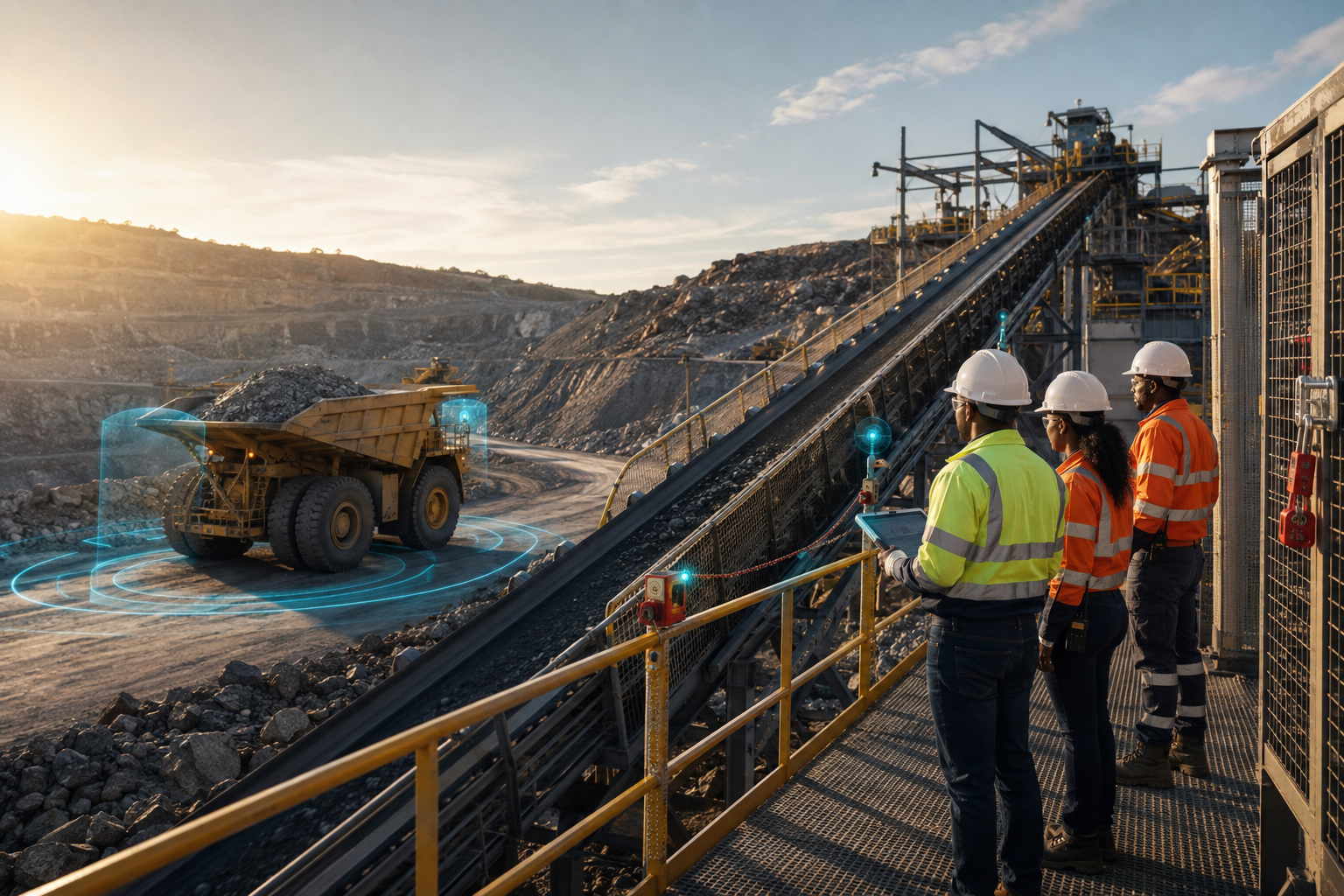
Collision Avoidance Systems and Proximity Detection Devices are strong examples. They recognise that human and machine interaction cannot depend only on attention, memory, visibility and reaction time. When people, haul trucks, loaders, drill rigs, light vehicles and pedestrians operate in shared spaces, the system must help detect danger, warn the right people and, where required, intervene before the consequence occurs.
That is the heart of mistake proofing: design the work so that a likely error is prevented, made visible immediately or stopped before it becomes harm, rework, equipment damage or lost production.
In practical terms, error proofing should help the operation do at least one of three things: prevent the unsafe or incorrect action, detect it early enough for intervention or stop the process before the consequence is released.
That simple logic - prevent, detect, stop - is what makes the concept powerful for mining operations.
From Detection To Prevention
Many operations have traditionally relied on inspection, supervision and correction after the fact. Those controls remain important, but they are not the same as prevention. Inspection finds the defect after it has been created. Prevention changes the condition so the defect is less likely to be created in the first place.
In manufacturing, this distinction is easy to see. A gauge can confirm whether a part was made correctly, but a fixture or interlock can prevent the wrong part, wrong orientation or wrong sequence from being accepted in the first place. Mining can use the same logic: do not only inspect for the unsafe or incorrect condition after it exists; design the task so that the condition is prevented, detected early or stopped before consequence.
Mining needs both, but operational excellence comes from shifting more effort upstream. The aim is not to blame operators, artisans, supervisors or planners for mistakes. The aim is to reduce how often the system puts them in a position where one missed step, one distraction or one unclear instruction can become a serious event.
The real question is not only "Why did the person make the error?" It is also "Why did the system allow that error to progress?"
What Mining Has Already Started
Proximity detection and collision avoidance are useful because they address a real red-flag condition: people and machines interacting in dynamic, noisy, visually constrained and high-consequence environments.
They also show several mistake proofing principles in action. They detect the presence of a person or another machine, warn the exposed parties, reduce dependence on line-of-sight visibility and, in more advanced applications, support automatic machine intervention when no action is taken.
Other examples are already familiar in good operations: isolation interlocks that prevent equipment restart while maintenance is underway, blocked-chute and belt-misalignment sensors that stop unsafe conveyor operation, and load-limiting devices that prevent unsafe lifting.
In South African mining, this direction is reinforced through Mine Health and Safety regulation requirements for trackless mobile machinery, including collision prevention, pre-use inspections, operating procedures, maintenance standards, isolation and lock-out, braking effectiveness, visibility and fatigue management.
That matters because it moves the discussion beyond "install a device" and into "build a capable control system". A device alone is not operational excellence. It must be supported by road design, traffic management, equipment condition, maintenance routines, operator licensing, event review, change control and leadership discipline.
This is where the concept becomes more interesting than the technology itself. The device is only one expression of the principle. The wider opportunity is to apply the same error-proofing mindset wherever a known human error can create a high-consequence event.
The Human Error Conditions We Must Design Around
Across manufacturing and mining, the conditions that make human error more likely are surprisingly familiar: time pressure, distracting work environments, high workload, vague or interpretive guidance, overconfidence, change or abnormal conditions, imprecise communication and late information.
Mining contains all of these conditions. A crew may be trying to recover lost tonnes after a delay. A maintenance team may be troubleshooting under production pressure. A supervisor may communicate a change verbally during shift handover. An operator may be confident because the route is familiar. A planner may receive late information about parts, permits, access or equipment availability.
In that environment, "be careful" is not enough. Error proofing asks better questions:
- Can the wrong action be physically prevented?
- Can the abnormal condition be made visible immediately?
- Can the task sequence guide the user instead of relying on memory?
- Can the equipment refuse to start, move or release unless the safe condition is met?
- Can information arrive before the work starts instead of after people have adapted?
- Can the same check be built into the work rather than added as another after-the-fact form?
These questions shift the conversation away from whether people should try harder and toward whether the operating system is designed well enough to support them under real conditions.
Production Applications
In production, mistake proofing should focus on the conditions that repeatedly create lost tonnes, dilution, rework, waiting time and unsafe improvisation. Manufacturing experience taught me to look for the point where the process first allows the wrong action to enter the flow. In mining, that point is often found at the interface between the plan, the equipment, the operator and the physical workplace.
Dispatch and fleet management systems can be strengthened with route permissions, geofenced exclusion zones, speed controls, loading-point rules and alerts when a machine enters the wrong area or queues in a high-risk location. Ore control can be supported with barcode, RFID, GPS or digital confirmation that material is loaded, tipped and blended according to plan. Drilling and blasting can use digital pattern validation, depth checks, charging sequence controls and hold points that prevent work from continuing when critical information is missing.
The practical shift is to treat every repeated production error as a design signal. If the same wrong tip, wrong sequence, wrong route, wrong material movement or wrong setup keeps recurring, the answer is not only more reminders. The process needs a control that makes the wrong action harder and the correct action easier.
In production, error proofing protects both tonnes and discipline. It prevents variation from quietly becoming the accepted way of getting through the shift.
Maintenance Applications
Maintenance is one of the richest areas for mistake proofing because many failures begin before the machine returns to service. Wrong parts, missed fasteners, incorrect torque, incomplete isolation, skipped functional tests and poor handover can all create downstream production and safety consequences.
Practical controls include kitted job packs that contain only the correct parts, tool boards shaped for missing-tool visibility, digital work instructions with mandatory photos at critical steps, calibrated-tool locks, torque confirmation, interlocked guards, electronic lock-out verification and post-maintenance functional tests that must pass before release.
A maintenance system can also be mistake proofed at planning level. Work orders should not be released unless parts, skills, permits, isolation points, special tooling and access requirements have been confirmed. That prevents the common mining pattern where the team arrives at the job, discovers a gap and then improvises under time pressure.
In maintenance, error proofing protects the return-to-service decision. It helps ensure that equipment is not simply repaired, but released with confidence.
Safety Applications
In safety, mistake proofing is about designing out exposure wherever possible. Collision avoidance and proximity detection are important, but the concept is much wider.
Examples include interlocked guarding, permissive-start systems, access control for restricted areas, lock-out systems that prevent restart, visual and audible alarms with clear signal codes, fatigue controls, seatbelt interlocks, brake-test controls, tyre inflation cages, lifting-point verification, barricading that physically prevents entry and pre-use checks with clear pass/fail criteria.
The best safety controls reduce the need for personal bravery. They do not ask people to remember every hazard while distracted, tired or rushed. They make the safe method the path of least resistance.
Error proofing does not replace risk assessments, competent people, critical control verification or safe work procedures. It strengthens them by reducing the chance that one human error is allowed to progress into a serious incident.
In safety, error proofing protects the person when attention, timing, visibility or communication is not perfect. That is exactly when a strong system should be strongest.
Where To Start
A practical implementation approach does not need to begin with a large technology programme. Best practices include a disciplined sequence: locate the defect or exposure, list the possible errors, determine the most likely error, propose multiple solutions, evaluate each solution, choose the best practical control, develop an implementation plan, measure results and update the affected documentation.
For a mine, that can become a focused routine:
- Identify the repeat event, near miss, breakdown, rework loop or workaround.
- Map the point where the error enters the process.
- Separate human error from the condition that made the error likely.
- Rank the risk by consequence, frequency and detectability.
- Choose a prevention control before adding another inspection layer.
- Test the control in the real operating environment.
- Update procedures, training, maintenance plans and visual standards.
- Review event data to confirm the control is working and being used correctly.
Leaders can also start by asking four practical questions during incident reviews, near-miss reviews and improvement meetings:
- Where are we still relying on people to remember under pressure?
- Which repeat incidents are actually design weaknesses?
- Which controls warn people but do not prevent or stop the unsafe condition?
- Which near misses should become engineered or process-design improvements?
The Operational Excellence Opportunity
Mistake proofing helps mining leaders connect safety, production and maintenance into one operating system. A collision event, a repeat breakdown, a wrong material movement and a missed isolation step may look like different problems, but they often share the same root pattern: the process allowed a known error to pass through too easily.
Operational excellence is built when those patterns are made visible and removed at source. That means moving from reminders to controls, from blame to system design, from inspection to prevention and from isolated technology projects to integrated operating discipline.
Manufacturing experience showed me that the best improvement work often made the correct action almost automatic. Mining operations reinforced the same lesson: error proofing can protect people and improve reliability when it is applied with discipline. Mining has already started this journey through technologies such as collision avoidance and proximity detection. The next opportunity is to apply the same principle deliberately across the rest of the value chain: design the work so that the right action is clear, the wrong action is difficult and the abnormal condition cannot quietly continue.
The real opportunity is not to make people more careful. It is to make the operation more capable of protecting people, quality and production when human error is most likely.
Selected References
- Mine Health and Safety Regulations, Chapter 8: Machinery and Equipment.
- Guideline for a Mandatory Code of Practice for Trackless Mobile Machines.
- ICMM work on safer vehicles and vehicle interaction controls.
- Lean manufacturing and poka-yoke practice applied through operational experience.
Ready to error proof the operation?
LuRea helps operations make recurring losses, safety exposures and maintenance workarounds visible, then convert them into practical prevent, detect and stop controls that improve performance and reduce risk.
Start a Conversation